
An uncontested divorce in Illinois can be quit simple – so long as you use a lawyer. As an uncontested divorce lawyer in Cook, Lake and DuPage counties, I find that whether it’s Chicago, Skokie, Deerfield or Wheaton, people often have the misconception that an uncontested divorce means a lawyer isn’t necessary. While it’s true that an uncontested divorce in Illinois can be affordable and fast, it’s important not to forget that divorce is as legal process best handle by a lawyer. I wrote this article to explain why people who want an uncontested divorce in Illinois should use a lawyer. (more…)
Author: David Wolkowitz
-
Lake Michigan oil spill like divorce?
Today there was an oil spill in Lake Michigan. It struck me that an oil spill can be a lot like a divorce: they are sometimes bigger than they look, are created by idiots, and take longer to deal with than expected. (more…)
-
How can I fire my divorce lawyer?
It’s unusual for a lawyer to talk about how to fire your lawyer. That’s why I’m writing this article.
Should you fire your lawyer? I don’t know. That’s for you to decide. To assist you in deciding I discuss reasons for firing a lawyer before discussing how to do it. (more…)
-
Lawyer referring to other lawyer?
Find a divorce lawyer in Illinois can be challenging. I know that many people are referred to lawyers by their friends and family, and sometimes by other lawyers.
But one thing I’ve found – from hiring lawyers myself – is that some referrals aren’t worth anything at all. (more…)
-
Uncontested Divorce: Top 5 Myths
If you are thinking about an uncontested divorce in Illinois, you may have talked to family and friends who have been divorced. Getting support from your family and friends is important. But the problem is they can spread the Top 5 Myths about getting an uncontested divorce.
This article is about dispelling the Top 5 Myths about divorce in Illinois. (more…)
-
Dating during divorce: Dissipation, alimony, custody
Many people wonder if they can date while getting divorced. Others contact me and complain that their spouses are cheating on them.
That begs the question, does dating while getting divorce have any effect on the divorce? (more…)
-
New “Right of First Refusal” statute: shame on the legislature
Many people have heard about a new “right of first refusal” provision that is taking effect on January 14, 2014. As an Illinois child custody lawyer, I find parents are often concerned about this issue. Too bad the new right of first refusal provision is a failure.
I wrote this article to provide a basic explanation of the law, and some commentary.
Long story short: the statute has no teeth and doesn’t go far enough in creating and protecting the right of first refusal in child custody and visitation situations. (more…)
-
No-fault divorce in Illinois: what is it?
As a divorce lawyer, many people contact me asking for help with a “no-fault divorce.” Most of those people are actually looking for an “uncontested divorce,” also known as a “amicable divorce” or a “divorce by agreement.”
I wrote this article to help people understand the term “no-fault” and why that’s not the same as an uncontested divorce.
Grounds for divorce in Illinois (more…)
-
Need a divorce attorney like you?
As an Illinois divorce lawyer working in Chicago and the counties of Cook, DuPage, Lake, and Will, I see all types of people. My clients are from diverse backgrounds. Many people think they need a lawyer who is just like them. I don’t think that’s true. (more…)
-
The best Illinois divorce lawyer? Tech matters
It seems like a lot of people want to know how to save money with a lawyer. If you are involved in a family dispute, or a divorce in Illinois, you probably want to know how to decrease the costs of litigation.
Whether you have one of the best divorce lawyers in Illinois, very expensive divorce lawyer, or a relatively affordable divorce lawyer, you probably want to know how to spend less money on your lawyer about getting the same result in your case.
Hiring an Illinois family law attorney is no easy task. Obviously, you want to hire an attorney that is best for you. To address that I wrote the article “Who is the best divorce attorney in Chicago?“
But there are other things you can do to make better use of your financial resources.
Use an attorney that leverages technology
While here are numerous factors that can make some one of the best attorney for you, one of it overlooks factor is the attorneys use of technology.
Let me explain to you how I use some technology. I use secure online storage to their clients can have easy access to the document. Then also enables them to easily send me documents. Further, I make extensive use of email, some attorneys do not. I use email extensively with communicating with my clients, and with opposing counsel. That saves a lot of money that would otherwise be wasted on the expense of postage and the time involved in mailing hard copy communication.
I ran across one attorney who did an excellent job leveraging technology for the benefit of her client. Chicago divorce lawyer Marie Fahnert received permission from a judge to conduct a hearing via Skype. In that case, the man was bed-ridden, and the attorney’s use of technology was key to the success of his case. While your case may not be that extreme, Attorney Fahnert’s case does illustrate the important role played by an attorney’s creative and effective use of technology.
Avoid unnecessary communication
One of the biggest wastes of time and money is creating unnecessary communication. Divorce and child custody disputes can be very stressful. But you should be careful not to use your lawyer as a therapist. First of all, lawyers do not tend to be good therapist.
You will also want to be careful not to flood an attorney with unnecessary communication about the facts of a case. In divorce and child custody cases, some facts are relevant to the proceeding, and some facts are not. Your lawyer should help you understand what facts are relevant. If you flood an attorney with too many irrelevant facts, you are likely to waste money and to distract from the more meaningful facts.
Organize your evidence
As an Illinois divorce lawyer, one of the most time-consuming aspects of my job is to organize my clients’ testimony and evidence. Here are a few tips you can use to keep your communication organized:
- Use email efficiently: Don’t send 10 emails a day, unless there is an emergency. It is much better to have one email with clearly delineated topics. Using bullet-points can help keep your emails organized.
- Label evidence effectively: I normally coach my clients how to keep their evidence organized. When clients send me their evidence in an organized fashion, that’s less time I have to spend organizing the client’s evidence. And that saves the client’s money.
Can your lawyer explain technology
The use of technology is one of the major drivers in attorney efficiency. But how can you determine how well your attorney utilizes technology? Most likely, at attorney would not just up and admit “I have no idea how to make use of technology, therefore our communication will be slow and your bill will be 10 percent higher.”
I suggest asking any attorney you’re thinking about hiring the following questions:
- Do you communicate via email?
- Can I access my case file online?
- Do you have the capability to conduct a teleconference?
- How do you prefer to communicate with attorneys on the other side?
A lawyer that cannot explain technology is probably not going to be any good at using technology to help you prove your case. Using technology can be important in cases involving hidden money, secret accounts, and cryptocurrency (like bitcoin); you can learn more about that at this article.
-
Is property split 50-50 in Illinois Divorce?
“Is property divided 50-50 in an Illinois divorce?”
As an Illinois divorce, I get that question a lot. The answer? Yes. And no
I wrote this short FAQ on division of property in an Illinois divorce.
How is property divided in an Illinois divorce?
Property is decided “equitably” in an Illinois divorce. Equitably is a fancy word for fair – it’s probably used just to make things seem more sophisticated. Lawyers like that. I’m just going to use the word “fair.”
A fair division of property might mean that you get 60 percent of the property, and your spouse gets 40 percent, or vice versa. Or perhaps the property will be split equally(50-50).
Who decides what is fair?
Judges decide what a fair division of property is, unless the parties can agree. If spouses can settle a divorce without a trial, or get an uncontested divorce, then the sp0uses choose for themselves what they think is fair.
But what if spouses don’t agree?
Then the judge decides what is fair. If you go to trial, you may very well find out that your version of fair does not comport with the judge’s version. Who do you think will win?
What property is divided in a divorce?
Not all property the spouses own is subject to division upon divorce. Only marital property is divided. Marital property is property that is acquired during the marriage – with a few exceptions that are beyond the scope of this article.
By the way, it doesn’t usually matter much whose name is on the property, or who purchased it. For example, if both spouses have separately-titled bank accounts that were opened and funded during the marriage, they might be under the impression that they get to keep an account simply because only his or her name is on it. That would be wrong. The accounts would be marital property and could be divided upon divorce.
Property division misconceptions are one reason I answer “yes” when someone asked me “Do I need a lawyer for a divorce in Illinois?”
For a bit more about dividing property, you might want to checkout my articles “Dividing property in divorce: Overview,” and “Uncontested Divorce & Marital Settlement Agreements: The Home.”
-
Divorce Mediation: Great benefits, path to uncontested divorce
Divorce mediation can be a way to speed up you divorce and avoid animosity. As a Chicago divorce lawyer, I write about many contentious topics on this site, including child custody, child support, and dividing marital assets.
But I want to make sure that people know about divorce mediation and some of what I see as the main benefits.
Mediation = Vegas?
What happens there, stays there.
What happens in mediation stays in mediation. In other words, mediation is confidential – for the most part.
Allow me to compare mediation to litigation in regards to privacy. (more…)
-
Order of Protection in Illinois Divorce: basic information
A couple weeks ago I represented a client who was defending against an emergency order of protection procured by his ex-wife. She accused him of myriad types of harassment, from posting threats on Facebook, to making threats of bodily harm on the phone. She also accused him of raping her.
I showed the judge she was a liar. (more…)
-
Alimony in Illinois: How much? How Long?
As an Illinois family law attorney practicing in Chicago, Naperville, Skokie and elsewhere, I know many people getting divorced have questions about how much alimony will be paid for how long. They often contact me with considerable anxiety about the issue.
First, you should know that in Illinois, what used to be called “alimony” is now called “spousal maintenance.” So that’s how I’ll refer to it in this article.
Here is the real truth: it’s up to the judge. All judges are different, and the facts of your case are different than the facts of other case.
Length and amount maintenance
The length and amount of maintenance is determined by the degree of existence of the following factors:
- The age of both parties
- The health of both parties
- The property owned by each party, including what was awarded in divorce
- The income and future earning ability of each party
- The needs of each party and the standard of living of the marriage
- The time required for the party seeking maintenance to become self-supporting
- The extent to which the party to receive maintainance contributed to the career/education/licensure o the other party
Termination of maintenance
If maintenance is awarded, these days its almost always temporary. For one year, two years, or something else. The days of lifetime maintenance are pretty much over.
But however long maintenance is for – whether that be through judgment or settlement – it can be terminated early.
Section 510(a-5) of the Illinois Marriage and Dissolution of Marriage Act (the “IMDMA”) outlines various factors that can be used by the court in deciding to terminate maintenance:
- Any change in the employment status of either party and whether the change has been made in good faith;
- The efforts, if any, made by the party receiving maintenance to become self-supporting, and the reasonableness of the efforts where they are appropriate;
- Any impairment of the present and future earning capacity of either party;
- The tax consequences of the maintenance payments upon the respective economic circumstances of the parties;
- The duration of the maintenance payments previously paid (and remaining to be paid) relative to the length of the marriage;
- The property, including retirement benefits, awarded to each party under the judgment of dissolution of marriage, judgment of legal separation, or judgment of declaration of invalidity of marriage and the present status of property;
- The increase or decrease of each party’s income since the prior judgment or order from which a review, modification, or termination is being sought;
- The property acquired and currently owned by each party after the entry of the judgment of dissolution of marriage, judgment of legal separation, or judgment of declaration of invalidity of marriage; and
- Any other factor that the court expressly finds to be just and equitable.
Hiring a spousal maintenance lawyer
If you are concerned about the payment of spousal maintenance (formerly known as “alimony”), there is probably enough at stake to warrant hiring an Illinois family law attorney.
If you are concerned about a change in maintenance – such as terminating, increasing, or decreasing it – that is accomplished by filing a motion in court. If you contact me we can get started.
As a lawyer who represents clients in spousal maintenance issues, I can’t guarantee results, but I make arguments designed to lead the court to the desired result.
You may also like to read my article, “Dividing property in divorce: Overview” and “Divorce in Illinois: Financial disclosure basics.”
-
Uncontested Divorce: One-stop Shop
As a Chicago divorce lawyer, I’ve got one word for people who don’t want to needlessly spend money on a lawyer. And that word is “sane.” I’m dedicated to helping people get an affordable divorce in Chicago, and elsewhere in Illinois.
Who can get an uncontested divorce?
An uncontested divorce can work regardless of income level, kids, or property issues. “It’s a myth that an uncontested divorce is only for people of modest means. The other week, a neurosurgeon contacted me about the process.
Whether you are a high net worth family or not, an uncontested divorce in Illinois might be an option.
Benefits of an Uncontested divorce
An uncontested divorce is almost always immensely less expensive and faster than one where the spouses fight it out. Divorce is about moving on with life. And often the easiest way to do that is to come to agreement and to put the past behind you. Many people can hire a lawyer for a flat-fee for an uncontested divorce.
My clients benefit from the efficiency of the process I use. I provide documents either by mail or electronically, and in an uncontested divorce, my client usually only has to appear in court once – when the divorce is granted. The divorce might take only one month.
Lawyer provides information about uncontested divorce
UncontestedDivorceInIllinois.com will not provide legal advice, but instead will help arm people with useful information and direct them to a divorce lawyer and Illinois family law attorney. Visitors will also be able to submit questions and have them answered by an Illinois family law attorney and Chicago divorce lawyer.
Questions that will be addressed include:
- What is the process of an uncontested divorce in Illinois?
- Can we both use the same lawyer in an uncontested divorce?
- How long does a divorce take?
- How do I find an uncontested divorce lawyer?
- What are the main issues we need to agree on?
- How is property and debt divided?
- What do we do about the house, and do I need an Illinois real estate lawyer?
- How much child support should be paid in Illinois?
Warning: “Online divorce” nonsense
People should be warned against using online websites to complete divorce documents without the assistance of a lawyer. Using a website to create legally binding documents can lead to what I call divorce déjà vu – problems the spouses think they solved, but instead, may rear their ugly heads years later. Instead of creating problems by trying to use a website as a lawyer, I can assist people with an affordable uncontested divorce so they can try to move on with life with less stress.
-
College Expenses for Divorcing & Unmarried Military Vets
As a Chicago divorce lawyer, I can tell you that many parents are flabergasted upon learning that a court can force them to pay for their children’s higher education through Section 513 of the Illinois Marriage and Dissolution of Marriage Act (the “IMDMA”), titled “Support for Non-minor Children and Educational Expenses.”

Getting this law changed should be a no-brainer. A good start would be helping Illinois’ unmarried veteran parents deal with a court ordering them to pay college expenses.
I am proposing a statutory amendment to assist unmarried veteran parents in paying for their children’s higher education. (more…)
-
Cheating and adultery: relevant to divorce in Illinois?
“He cheated on me,” my new client told me. “Isn’t there anything I can do about that?” she asked.
As a Chicago divorce attorney, I’m asked that type of question about adultery frequently. And while adultery and cheating often make headlines – for instance with General David Petraeus’ resignation from his position as the
 director of the CIA – people interested in divorce in Illinois should realize this one truth: cheating and adultery is almost totally irrelevant to getting divorced.
Below is a brief breakdown of cheating and adultery as applied to divorce in Illinois.
Grounds for a divorce and the “waiting period”
When someone files a “petition for dissolution of marriage” to start off of divorce, he or she must allege grounds for a divorce. Most people allege “irreconcilable differences,” or what people often refer to as “no-fault.” While it is true that adultery can be alleged, almost no one does that any more – not even those who have been cheated on.
In Illinois, when citing “irreconcilable differences” as the grounds for divorce, parties must have been living “separate and apart” for two years before being granted a divorce, a period that can be reduced to six months of both parties agree.
However, when citing “fault-based” grounds such as adultery, there is no waiting period. So for some wanting a quick divorce, it might be tempting to allege adultery. However, proving adultery is time-consuming, and expensive, and quite likely will not speed up the finalization of a divorce.
Dividing marital property
When getting divorce, marital property is divided, while parties’ non-marital property is not divided. Someone who has been cheated on may think that because he or she has been wronged, then the other party should get less of the marital property. Alas, it doesn’t work that way. Adultery is totally irrelevant to the percentage of the marital property awarded to either party.
Spousal Support, known as “alimony”
Did your husband or wife cheat on you? If so, that hurts. But it will have zero impact on the amount of spousal support (aka alimony) that is paid, if any. Some lawyers make think that characterizing a spouse as a “cheater” will make a judge dislike the spouse, and and that the non-cheater will somehow benefit. But that is unlikely – most divorce judge are too busy to worry about something that is legally irrelevant.
Dissipation
The issue of dissipation is the only area in which adultery is pragmatically relevant. Dissipation occurs when, sometime after the irretrievable breakdown of a marriage has begun, one spouse uses marital funds for non-marital purpose. For example, if a husband buys his girlfriend a $200,000 condo in Las Vegas, those funds have been dissipated, and the wife should essentially be paid back. Dissipation can stem from many different activities aside from adultery, like gambling or an addiction to drugs.
-
Do I need a Chicago divorce lawyer?
Most people don’t want to spend money on a Chicago divorce lawyer. I have one word for those people – sane!
Unfortunately, when seeking a divorce in Illinois (called a “dissolution of marriage”), when spouses try to handle a divorce on their own, mistakes happen, and time is wasted. I wrote this article to address some common questions about hiring a family law attorney in Illinois.
Do I need a lawyer for a divorce in Illinois?
No, you don’t need a lawyer. Likewise, when you are a passenger on a plane, you don’t need a pilot – but things might go a bit smoother a trained professional at the helm.True, there is a lot of free information out there about how to get a divorce. Some services help you draft material you need to file for divorce. However, an Internet-based form will not answer anyone’s questions, should they arise.
I can tell you from experience that people often have misperceptions about the law of divorce in Illinois – most of which is in the Illinois Marriage and Dissolution of Marriage Act. For example, people often think because one one name is one a bank account, that bank account is absolutely the sole property of the spouse whose name is on it – but that’s not true.
The point is, if you are using a form to help you get divorced without a lawyer, you run the risk of making ill-informed decisions that could impact your life for years to come.
My husband/wife and I agree on everything, we don’t need a lawyer, do we?
Even when people agree, having a lawyer can have benefits for both. First, even if only one party has a lawyer, at least the settlement agreement will be written in a professional manner.
Further, unfortunately, sometimes people think that both spouses are in agreement – but they find out differently later. I cannot tell you home many times a client has said to me “We’re very amicable, I don’t think we’re going to need to worry about that issue,” then a couple months down the line, those same people are driving each other nuts with disagreement. A lawyer can help prevent problems.
It won’t take me too much time to get divorced in Illinois, will it?
It depends what you consider “too much time.” You will need to go to court to file papers, figure out how to draft agreements, and deal with court procedure. Then, you have to actually appear in court several times if you are trying to handle your divorce yourself. Maybe you don’t want to take off time for work? Maybe you don’t want to waste a lot of time with confusing legal forms? That’s another reasons to hire a lawyer.
After we get divorced, will we every have to come back to court?
It’s possible – especially when the divorce doe not appropriately wrap up all the loose ends. Here’s an example involving a house. During a marriage, the wife agreed to co-sign on the sister-in-law’s mortgage. The spouses drafted their own settlement agreement, which included a provision that stated the husband would indemnify the wife against any payments for his sister’s mortgage. However, since the agreement wasn’t professionally drafted, and the judge who approved it must not have read it, the wife (now ex-wife) had to hire me to clean up the mess. And frankly, at this point, it might be impossible to fix everything.
Long story short, prevent divorce deja vu – don’t try to go it alone and create the risk you will have to revisit the matter years later.
We want an uncontested divorce – can we use the same lawyer?
Some lawyers might agree to represent both parties. If you find one that will – run!
For an uncontested divorce in Illinois, many people want to have both spouses use the same lawyer. But if a lawyer does that, he or she cannot give any legal advice to either party – and that can be a problem. Instead, what I often do is represent the petition in an uncontested divorce (the petition is the person who files for divorce), and i draft all the agreements. Then, the other party (the respondent) can either choose to represent him/herself, or can hire a lawyer to simply review the documents and to appear when the divorce is finalized at the “prove up.” The advantage to this system is that the spouses to have to hire two lawyers to do duplicative and expensive work – the second lawyer’s job is potentially very light and relatively inexpensive.
We don’t have any assets, do we will need a lawyer?
Often people tell me they don’t have any assets, then it turns out they do. The following are examples of assets: checking account, savings account, CD, bonds, stocks, cars, electronics, art work, interests in businesses (even if currently in red), houses. There are few people getting divorced that truly don’t have any assets.
Also, assets are only one half of the marital financial pictures – there is also debt. Marital debt can be divided, just like an asset. Is there a car loan in both your names? That can be divided. Is there a mortgage in both your names? You’d probably want that divided.
By hiring an attorney, you can have a professional manage the process of divorce in Illinois. Otherwise, you risk not properly accounting for assets and debts. When that happens, you could have a nasty surprise years later.
We already divided our assets, so that part is done, right?
No. That’s because in Illinois, when people are married, unless there is a pre-nuptual or ante-nuptial agreement, ownership is not determined by title to any
given assets. Therefore, despite the fact that you think your assets are divided, they are not divided in the eyes of the court.For example, a wife may have a bank account that is only titled to her – the husband’s name is not on it. However, because they are married, that bank accouwith the wife’s name on it is still considered marital property and subject to division upon divorce.
-
How to find a good divorce lawyer in Chicago
If you seeking a divorce in Chicago, you may have several options in finding a divorce lawyer. You could ask a friend for a referral, walk into a lawyer’s office around the corner, or use the yellow pages (just kidding).
As a Chicago divorce lawyer, I am available to help with your Illinois family law problems. But here are a few general tips for finding a lawyer.
Here are a few tips to finding a Chicago divorce lawyer.
- What happens during your consultation: If a lawyer doesn’t give you any insight, he or she might not be the one for you.
- Does the lawyer tell you what you want to hear: Don’t hire someone who just tells you what you want to hear. Often, both people in a divorce feel as though they lost. Hire someone who is realistic.
- What are you big issues? In the presidential election, winning Ohio was a major goal for both candidates. This is a good lesson for those in divorce. Don’t get lost in the minutia, keep focus on the major issues.
If you are looking for a good divorce lawyer in Chicago, contact me, Chicago family law attorney David Wolkowitz. -
Divorce Frankenstorm: When forces collide
Hurricane Sandy is producing what some call a Frankenstorm – the collision of a hurricane and a one or two Nor-easters. Apparently the Frankenstorm is a near cataclysmic combination of various storms. As a Chicago divorce
 lawyer, I think there can be a sort of Divorce Frankenstorm. If you need help now, you can contact me, Chicago divorce lawyer Dave Wolkowitz. Or, see what constitutes a Divorce Frankenstorm below.
What is a Divorce Frankenstorm?
No one (normal) gets married in Illinois thinking he or she will get divorced. But it happens. Some people are able to have an amicable divorce – those people might consider an uncontested divorce in Illinois. However, one small contentious issue can lead to problems. If your divorce has at least three of the below, you may have a major battle on your hands:
- Spouse is mentally unstable: Mentally unstable spouses may blame others for their problems, and make false accusations.
- Spouse is a leach: If your spouse is a leach – happy to enjoy the so-called “marital estate” without putting forth significant effort to earn income, you are likely dealing with someone who wants something for nothing.
- Too much money: Somehow it seems to be rich people who create the most pain fighting over money – when they need that money the least. Sometimes, people just choose to go their own way and leave with what’s fair. Others seek to maximize their gains. When that happens, people get offended and did in their heels.
- Parental alienation: Some parents really can’t help themselves from alienating children from the other parent. It’s sick, but it happens.
-
Uncontested Divorce: important information
Interested in an uncontested divorce in Illinois? If yes, you are like many people getting divorced. If you are ready to get started, and contact me, uncontested divorce lawyer David Wolkowitz. For a bit more information, here are some super brief points you should consider:
What is an uncontested divorce?
The spouses must agree on everything. Assets, debts, kids visitation, child support, spousal maintenance (alimony), and so forth. If you are not in agreement on all those things, perhaps your divorce will not be very combative, but it cannot be completed as quickly as a totally uncontested divorce can be done. For more information about one of the more complicated aspects of an uncontested divorce, see my article, “Uncontested divorce and marital settlement agreements: the Home.” It is important to understand when an uncontested divorce probably will not work – for more about that, see my article, “Uncontested divorce: When won’t it work?”
How long does an uncontested divorce take?
The principal determinant is how long the parties take to review the settlements draft by the lawyer. If that review is speedy, spouses can be divorced in less than a month.
Can we use the same lawyer?
Any lawyer who represents both parties in a divorce should retire immediately. However, many people get divorced while only one of them has a lawyer. For example, I might complete the settlement agreements according to terms agreed to by my client and the spouse. Then, the spouse can review those agreements, approve them, then the divorce can be finalized on those terms. See my article, “Uncontested divorce: Can we use the same lawyer?” for more insight into this issue.
What if my uncontested divorce becomes contested?
If an uncontested matter becomes uncontested, then you can either give up, or fight. If I am representing a client in an uncontested divorce, and it becomes contested, that client can choose to have me represent him in the contested matter.
How man times will I have to go to court for an uncontested divorce?
In literally 99.9 percent of my uncontested divorce cases, there is only one court date. In very rare occasions, if the facts are very unique and the judge insists, there might be more than one court appearance. And most of the time, the only spouse require to appear is the one that files the case. But again, that is ultimately up to the judge.
How can I get started?
I make the process very simple. It is as follows:
- You agree to have me represent you
- I send you spreadsheets to fill out
- We talk briefly
- I draft your agreements
- I send you agreements to approve, if necessary, I make changes
- Your spouse reviews, then approves
- I file everything in court, then the divorce is finalized about 2 weeks later when we appear at a “prove-up”
For an uncontested divorce contact me, Chicago family law attorney David Wolkowitz. I also wrong a longer article on uncontested divorce titled, “Uncontested divorce in Illinois: FAQ.”
-
Short sale in a divorce: overview
As a Chicago divorce lawyer, I can tell you that even for those in an uncontested divorce in Illinois, what to do about the house is often a problem. One possibility may be a short-sale. (more…)
-
High-net worth divorce: overview
A high-net worth divorce in Illinois may involve many of the same issues as other divorces, with a bit more complication. When the case calls for it, I can work with a network of professionals to provide high-net worth individuals with the expertise needed in preparing for divorce. (more…)
-
High Net Worth Divorce: FAQ
As a Chicago and Lake County divorce lawyer, I understand that high-net worth people have concerns particular to their wealth. You may read the following FAQ or contact me to discuss your situation.
- Are assets split 50/50 in an Illinois divorce? The judge might divide assets right down the middle, but is not required to. That’s because in an Illinois dissolution of marriage (divorce), judges divide assets “equitably.” What does that mean? Essentially, a judge will divide assets according to what he or she thinks is fair, based on a variety of factors. That could mean a 50/50 split, a 60/40 split, and so forth.
- Will I have to pay alimony? Alimony is now referred to as “spousal support.” Spousal support is supposed to be rehabilitative; in other words, it is not supposed to last forever. Judges may use discretion when awarding spousal support, and they are supposed to award support such that the person receiving the support can maintain the standard of living enjoyed during the marriage.
- How much child support will I have to pay? Child support is set by statute, but deviations are possible. One of the deviations that high-net worth individuals are often concerned with are deviations for high-earners. For example, as outlined in my article “Illinois child support: the basics,” without any deviation a payor of child support would pay 20 percent of his or her net income pursuant to statute. However, a child support payor may receive a downward deviation if the net income is more than a certain amount; Cook County judges generally allow a downward deviation when the payor’s net income is at least $200,000, and DuPage County judges generally use the $300,000 as the point at which they deviate downward for high earners. You can see my article titled “Child support in Illinois: reduced below guidelines” for an example of a case where I won a deviation for my client.
- What about my business in a divorce: Business can be marital property if they were started or acquired during the marriage. You may want to view my article titled, “Dividing property in divorce: Overview.”
- How long will my divorce take? High-net worth divorce can take longer because there are more issues to consider, and because the parties can afford to litigate those issues. The best thing to do is to consult an Illinois family law attorney to get a better idea of the issues involved in your case.
- How much will my divorce cost? It is impossible to say how much a divorce will cost. Consider that you will simply have to determine if spending money on legal fees is worth it, considering the potential (but uncertain) payoff.
Getting a lawyer for a high-net worth divorce
If you are concerned about your property, that’s understandable. And whether or not you support vice-presidential candidate Paul Ryan, I might be able to help. You might be interested in a consultation with me, Chicago divorce lawyer David Wolkowitz. You may contact me online or at Three-One-Two-554-5433 .
-
Parenting time: the right of first refusal
Divorcing parents in Illinois often have conflict over who will spend what time with the kids. As a Chicago divorce lawyer, I find that one way to maximize each parent’s time with the kids is to include a “right of first refusal” in a joint parenting agreement (JPA).
You may contact me, Chicago divorce lawyer David Wolkowitz online – and read below to learn a bit about the right of first refusal.
What is a right of first refusal?
It is never easy to allocate parenting time in an Illinois divorce or child custody dispute – but the right of first refusal can help make this easier. Right of first refusal in custody situations commonly means that one parent must first offer the other parent the opportunity to look after their kids before contacting a babysitter or another family member to care for the children.
Right of first refusal typically applies to both planned and last minute situations. Therefore, if a parent makes plans for night out with friends two months, or even two days, prior to the actual event, they must offer the other parent the option to care for their children before making any other arrangements. If the other parent decides not to take the kids during this time, then a third party caretaker such as a friend, babysitter or other family member may be asked to care for the children instead. Right of first refusal may also apply to situations such as doctor’s appointments, vacations, after school daycare, and many other instances.
Benefits of the right of first refusal
The right of first refusal helps parents avoid conflict because it helps maximize each parent’s time with the children. Further, when the right of first refusal is included in a JPA, parents are more likely to keep each other informed – and that can lead to better parenting. Ultimately, some of the stress inherent in divorce can be reduced.
Dealing with your custody issue
I know that visitation and parenting time can be one of the most contentious issues in a divorce. As an Illinois family law attorney, I think helping my clients spend as much time as possible with their children is one of my most important goals.
If you are concerned about your time with your children, that’s understandable.You might be interested in a consultation with me, Chicago divorce lawyer David Wolkowitz. You may contact me online or at Three-One-Two-554-5433 .
-
Dividing property in divorce: Overview
As a Chicago divorce lawyer who deals with division of property and high net worth divorces, I know that people have many questions about – to put it bluntly – keeping their stuff. You don’t have to be in a high-net worth divorce in Illinois to be concerned that you keep as much of your property as possible. (more…)
-
Want to divorce an alcoholic in Illinois?
As a Chicago divorce lawyer, I find that an alcoholic husband or wife is one of the hardest situations for a person to deal with in a divorce. Often a person married to an alcoholic will feel like the situation is unfair. And it probably is. That’s why a fresh start may be the best thing.
Problems with kids and custody
An alcoholic parent is normally a bad parent. Even if the alcoholic is not abusive, it is likely that he or she is not putting a full effort towards parenting. When a parent is an alcoholic, alcohol-related problems can translate into restricted visitation or parenting time. (more…)
-
Child custody in Illinois: evidence basics
As a Chicago divorce lawyer, I tell clients that in a child custody case, most decisions will be made according to the child’s “best interests,” pursuant to Section 601 of the Illinois Marriage and Dissolution of Marriage Act (the “IMDMA”). Therefore, in a child custody matter, a parent’s lawyer needs to apply the law to the sometimes confusing facts of a case.
Evidence in a child custody case in Illinois
Parents in a child custody case can be overwhelmed with evidence, or potential evidence. Part of the challenge is to determine what evidence is relevant, and what is not. It’s not productive to spend time on worrying about gathering evidence that would not be meaningful to a judge. Also, as I wrote in my article “Illinois child custody: Liars common, but not invincible,” lying in child custody cases is commonplace – proper evidence can be effective in defeating lies.
Evidence in a child custody case may include:
- testimony from parents and others
- social media websites (Facebook, etc)
- photographs
- videos
- emails
- text messages
- psychological reports
Getting organized
Parents in a child custody case are rightfully concerned about the cost of the case. To minimize costs, it is important to use a lawyer efficiently.
When I help a parent gather evidence for an Illinois child custody case, I like to help the parent understand how to organize the evidence, and how to communicate its relevance. As a Chicago child custody lawyer, I know that my clients benefit when I spend less time sorting through mounds of evidence, and more time determining how to best utilize that evidence.
Keeping the goal in mind
In a child custody case, the major topics of disagreement are legal custody and parenting time. You will want to gather evidence that is useful for the goal you are trying to achieve.
Legal custody: Legal custody requires a determination of whether parents will have joint legal custody, or if one will have sole legal custody. Whether a parent has joint or sole custody does not determine how much time the child spends with each parent.
Parenting time (visitation): One parent may have sole legal custody, but a child still might spend equal time with both parents. Or, parents might share joint legal custody, but the child may spend 80% of his or her time with one parent.
-
Illinois child custody: Liars common, but not invincible
As a Chicago divorce lawyer, I see people lie frequently. Very frequently. But in a hearing a few days ago, I almost completely dismantled the opposing client under cross-examination.
Good news: liars are often stupid
The problem with Illinois family law is that so much of it is “he said, she said.” There is so much “creativity” in testimony that’s it’s a wonder that judges don’t burst out in laughter.
However, the opposing party in my recent hearing seemingly has no bounds to her dishonesty. Though the case has been going on for more than six months (and my client was previously represented by a high-priced lawyer in a fancy building), the recent hearing was the first one wear the opposing client was actually made to account for her crazy accusations.
Child custody liar folded under cross examination
Under my cross examination, the other party stammered like a fool, to say the least. The problem for her was that her lies and intentional mischaracterizations have become so extravagant that she can’t possibly maintain believability.
I think one of my important tasks is to help my client focus on which of the other party’s lies are potentially substantive, and which are drivel. Then, of the lies that are substantive, I believe in helping my client assembler the evidence required to expose the other party appropriately.
People that lie in court commit perjury. It is almost impossible to get the state’s attorney to prosecute a perjury case. However, one can also be held in contempt of court for lying in court – an option I’m more than willing to explore for my clients.
It is important to understand that child custody liars don’t just lie on the stand, they lie at every opportunity, such as in a UCCJEA judicial teleconference when the are trying to effectuate what amounts to a kidnapping; see my article titled “Interestate child custody jurisdiction: UCCJEA ‘judicial teleconference’ is critical” to find out more about that.
-
Same-sex divorce: Illinois in the Stone Age
As a Chicago divorce lawyer, I come across people who are anxious to move on. For people in Illinois with a family law problem, I can usually help. But the other day, someone called me interested in a same-sex divorce. (more…)
-
Divorce in Chicago: Financial disclosure basics
As a Chicago divorce lawyer, I find many people who want to get a divorce in Illinois are confused about handling financial matters. While people generally think they will split some property when they get divorce, financial discovery in divorce is more often a foreign concept. It can lead to some confusion.
Put simply, financial discovery is the process by which each spouse ascertains the financial assets of the other spouse, and the marriage as a whole. Basically, it’s gathering financial evidence. I wrote this FAQ on financial discovery in Illinois divorce to help people understand what will be necessary during a divorce.
-
Bigamy: In Illinois, it’s not just a thing of the past
Many people think that bigamy is a thing of the past. Most people can barely handle one spouse – why would anyone want more? If you need help with bigamy, contact me, Chicago divorce lawyer David Wolkowitz – I might be able to help.
Causes of Bigamy
There are a couple reasons bigamists could be married to more than one person. They include:
- It’s a con: Bigamists might just be out to scam people out of their money and stuff. Some bigamists aren’t out for financial gain, but they lie about not being married so they can get married again.
- Stupidity or confusion: Some people are stupid. Some of those stupid people get married, think they are divorced, but aren’t. Then they get married again. This is becoming more popular due to increased immigration. For example, a person is married in Poland, immigrates to the United States, then tries to divorce the spouse in Poland – but the divorce never goes through.
The Illinois law on bigamy
Section 212 of the Illinois Marriage and Dissolution of Marriage Act addresses bigamy, or “Prohibited Marriage.” It prohibits ”a marriage entered into prior to the dissolution of an earlier marriage of one of the parties” is prohibited (750 ILCS 5/212 (a)). In other words, it prohibits bigamy.
The remedy to a bigamous marriage can be found in Section 301 of the Illinois Marriage and Dissolution of Marriage Act (750 ILCS 5/301). To end a bigamous marriage, a court must enter an order declaring the marriage invalid; this was formally known as an annulment. A victim of bigamy would file a Petition for the Declaration of Invalidity of Marriage with the court, and procuring an order of invalidity would most likely be a simple matter or proving the bigamist was married at the time of the marriage the victim is not seeking to have declared invalid.
Dealing with bigamy in Illinois with a Chicago divorce lawyer
Bigamy is a serious harm to its victims. But, ending a bigamous marriage can be relatively simple because there often simply isn’t much to debate: it’s wrong, and it must end. However, if there are children involved, there may be complicated child custody matters to sort out. Further, bigamy can have an impact on who will inherit what should any of the spouses die during the bigamous marriages.
-
Uncontested Divorce: When won’t it work?
Sometimes, an uncontested divorce won’t work. To find out when that might be, see below.

Plans for an uncontested divorce can blow up. - Children: In a divorce, child custody issues can be complicated. Even where parents are aiming for an amicable divorce, they sometimes realize they do not agree on how to handle the children. Matters with children are one of those areas were a small problem can create a much longer one.
- House that is underwater: In today’s market, many homeowners own homes on which their mortgage balance is greater than the value of the home. This situation can several strain a marriage, and a divorce – because people cannot agree on how to divide the debt. If spouses can’t agree on how to get out of a home, they probably won’t be able to agree to how to get out of a marriage.
- Mental illness in the marriage: If one spouse suffers from a mental illness, particularly one that is untreated, coming to a sensible marital settlement agreement can be difficult.
- One spouse is uninformed: In an uncontested divorce, the idea is that people are working together. However,if one spouse is uninformed as to his or her rights before coming to an agreement, then becomes aware of his or her rights before the divorce actually occurs, the entire process could be derailed.
- Nasty divorce lawyers: It’s sad to say, but some lawyers operate in a totally unethical manner. They try to stoke in order to run up the bill. Spouses who have truly talked about most issue in the divorce, and who are interested in an uncontested divorce in Illinois, could benefit from choosing their lawyers wisely.
Below is some other information about uncontested divorce:
What is an Uncontested Divorce in Illinois?
Phases of an Uncontested Divorce in Illinois
Uncontested divorce: a lawyer’s role
Uncontested Divorce & Marital Settlement Agreements: The Home
-
Uncontested Divorce: “Can we use the same lawyer?”
One of the most common questions I get as an uncontested divorce lawyer in Chicago is “Can we use the same lawyer in an uncontested divorce?” Technically, you could. But, there are some very good reason why you should not, and I list some of those below. Feel free to contact me, uncontested divorce lawyer in Chicago Dave Wolkowitz – I may be able to help.

Achieve peace through an uncontested divorce in Chicago - Lawyers refuse: Most lawyers will refuse to represent both parties in a divorce.
- Advice is restricted: If you use the same lawyer as the other party, you will not receive advice that is confidential. You won’t be fully informed. And even though it is an uncontested divorce, being properly advised is still a good idea.
- Uncontested can turn contested: Sometimes people start a divorce as an uncontested matter, then it turns contested. If both parties are using the same lawyer – and that happens – then both people have to get a new lawyer. That’s not an ideal situation, and can cause added expense.
If you are interested in an affordable divorce, then an uncontested divorce lawyer in Chicago can assist you by drafting a settlement agreement. Then, your spouse could hire a lawyer simply to review that agreement and to show up at the prove-up (when the divorce actually happens, in court). By having one lawyer do most the work, then a different lawyer simply review the material for the other party, you can save money.I have written numerous articles on uncontested divorce that you might enjoy:What is an Uncontested Divorce in Illinois?
Phases of an Uncontested Divorce in Illinois
Uncontested divorce: a lawyer’s role
Uncontested Divorce & Marital Settlement Agreements: The Home
If you are thinking about an uncontested divorce, I’m happy for you. You will likely be much better off than those people who waste their hard-earned cash on lawyers they don’t need. I understand divorce is difficult, and that’s why I often meet clients in their choice of locations. So whether you are in Evanston, Schaumburg, Burr Ridge – or wherever, feel free to contact me about an uncontested divorce. What’;s more, much of the work can be done over the phone – and for an uncontested divorce, you only need to show up once in court.
-
Uncontested Divorce & Marital Settlement Agreements: The Home
Particularly with the current housing market, people getting divorced are concerned with what to do with their home. Today, many people are trying to figure out how NOT to get stuck with the home – instead of maneuvering to keep it. If you are interested in an uncontested divorce, dealing with your home – and its mortgage – should be one of your first priorities. If you are interested in an uncontested divorce in Chicago, Illinois, I can help; contact me – an uncontested divorce lawyer in Chicago.
To sell, or not the sell. That is the question.
Here are some options for dealing with your home in an uncontested divorce.
- Sell the home. The house can be sold prior to the divorce, but then the division of the proceeds, if any, will be not certain until a settlement has been reached. Therefore, a marital settlement agreement (MSA) can be drafted such that it contains a clause that provides a framework for selling the home. For example, an appraiser and broker can be specified so that the ex-spouses need to be minimally involved when the post-divorce house marketing process begins.
- Refinance. If one spouse is to keep the house after the divorce, the spouse that will remain in the house will often refinance the house in his or her name. But beware, you can’t just call up the mortgage company and say, “I’m getting divorced, can you take my spouse off the loan?” There are procedures to be followed. For example, the person who is going to be the sole borrower on the refinanced loan must qualify as such. If this is the option you choose, it is likely that your MSA will need a custom-crafted clause addressing refinancing the home.
- Hybrid/Other. There are a variety of ways ex-spouses can share responsibility for a home. For example, both names can be on the title, and one spouse can contribute to the mortgage payments. However, there are many details to work out, such as what happens in the mortgage becomes delinquent, what happens if the person living in the home does not properly maintain it, and so forth.
The financial benefits of an uncontested divorce are overwhelming. Therefore, it may benefit people seeking an uncontested divorce in Chicago to carefully consider all aspects of their divorce. Once a basic agreement is reached, an Illinois family law attorney an help you draft a sensible marital settlement agreement. Feel free to contact me about your uncontested divorce in Chicago or Illinois.You may also wish to view the following articles I’ve written: -
How to Get more Child support
Many people contact me stating that they want to get more child support in Illinois. If you have a child support order in place, to get an increase you must file a petition to modify support. As a Chicago family law attorney, I might be able to help – contact me for a consultation.
Please consider the points if you are interested in increasing your child support:
Substantial change in circumstances required: The law regarding support modification requires there to be a substantial change of circumstances after the date of the last support order for support to be modified. For the most part, that means the judge must find the “net income” of the child support payor has significantly increased.
When the payor’s “net income” increased, but child’s needs remain the same: Though historically Illinois courts required both an increase in the payor’s net income and a showing that the child’s needs have increased, currently court’s often award an increase in support even without a showing that the child’s needs have increased. In other words, child support might increase simply because the payor is earning more – even if the child needs have not increased.
-
Illinois’ Family Law Clients’ Bill of Rights
If you are seeking a divorce in Chicago, Illinois, it is important that you have an attorney that respects your rights. As a client in a family law matter in Illinois, your rights are outlined in Section 508(f) of the Illinois Marriage and Dissolution of Marriage Act, which appears below. (more…)
-
Uncontested divorce: a lawyer’s role
People interested in an uncontested divorce in Illinois are often interested in minimizing the cost of their divorce. In general, I find that people are sometimes curious about the scope of a lawyer’s involvement in an uncontested divorce.
Below I address some common questions regarding lawyers’ involvement in uncontested divorces.
Do we both need a lawyer for an uncontested divorce?
One lawyer is more than enough to draft the materials needed, such as a marital settlement agreement, and joint parenting agreement. Further, most attorneys will supply the other party with the forms they should fill out In order to move the case forward.
Therefore, an uncontested divorce is affordable because it doesn’t involve needless disagreement and litigation, and because it can be accomplished with only one lawyer.
Can one lawyer represent both of us?
In theory, one lawyer could represent both people, so long as the joint-representation is disclosed. However, it is a very bad idea to do so – and most lawyers won’t do it, including myself. It might be a bad idea to search for a lawyer who will represent both parties in a divorce, because one who accepts such a job is probably suspiciously desperate for business.
What if my spouse is worried about being tricked into an agreement?
As outlined in my post “Phases of an Uncontested Divorce,” the crux of any uncontested divorce is a martial settlement agreement (MSA) and, if the parties have kids, a joint parenting agreement (JPA). Truth be told, both the MSA and JPA should be written in plain English, and both parties should be able to understand them.
However, even when a divorce is amicable and uncontested, it’s understandable that a spouse without a lawyer might feel exposed without the advice a lawyer. Anyone can at any time hire a lawyer, even in an uncontested case. So a person who starts off without a lawyer can hire one later, for ongoing counseling, or simply to review the proposed settlement agreement
What if I want my lawyer to explain the process to my spouse?
Normally a lawyer for one person does not speak to the spouse. In fact, if the adverse party is represented by counsel, doing so is not only unnecessary – it is against the rules of professional conduct lawyers must follow (with few exceptions).Further, many attorneys offering uncontested divorce services state in their agreements that they will not speak to their client’s spouse.
However, if a client wants me to speak to the spouse, I’m open to the possibility (some lawyers refuses to speak to spouses in an uncontested case). What’s necessary in that case is 1) the non-client spouse signs a statement acknowledging that I am not his or her attorney (to avoid misunderstandings), and 2) the client acknowledge that speaking in front of the spouse effectively waives the attorney-client privilege
What if things start to get heated?
A divorce that starts out as uncontested can become contested – parties might find out they don’t agree to the extent they previously believe. If that is the case, the same lawyer who you were dealing with for your previously uncontested case can continue to handle the case if it becomes contested.
How often do we have to meet?
Particularly in an uncontested divorce, meetings can be kept to a minimum. After all – most people have better things to do hang out with lawyers! In fact, it is possible to get an uncontested divorce and only meet your lawyer once in person – and that’s the day you actually get divorced – in court!
How do I get started?
You can contact me, Chicago divorce lawyer Dave Wolkowitz. I’ll try to give you a call back as soon as possible. I can answer your questions about the uncontested divorce process – and you will deal with me directly. In fact, to accommodate prospective client’s busy schedules, I’m more than happy to speak on evenings and weekends. I’ve developed an efficient process to handle uncontested divorces, including the use of online file storage and e-signatures – to save everyone’s time. My goal will be to handle your divorce with minimal disruption to your life – so you can move on.
You might also want to review my posts entitled “What is an Uncontested Divorce in Illinois?” and “”Phases of an Uncontested Divorce in Illinois“
-
Child custody emergencies: act quickly
If you have an Illinois child custody emergency, you may need to act quickly.
Consider the situation encountered by one of my colleagues. He received a very distressing telephone call from a mother in child custody dispute. She was in an absolute panic. “They’re going to take away my two girls,” she said.
She felt there was clear evidence that the father was abusing the children, but she couldn’t make her case in court.

She tried her best to explain her situation between bursts of tears. The father had hired an attorney and the mother did not. She said there was a court hearing in only a half hour, and it was about whether the mother would be jailed for disobeying a court order by keeping her children from their father. According to the mother, she had good reason to keep the girls away from their father. But now, she was in hot water – even though she wanted to protect her children.
She needed a lawyer to help her make her case to the judge that she was justified in disobeying the court order. But by the time she realized she needed help, it was too late.
If you are in an Illinois child custody dispute, it may very well be in your best interest to consult a Chicago divorce lawyer. While you understandably don’t want to waste money on at attorney, as the case just described shows, you could be setting yourself up for a major problem.
If you have an Illinois child custody emergency, please contact me, Chicago, Evanston and Schaumburg family law attorney David Wolkowitz; I may be able to help.
-
Kim Kardashian: domestic violence on display before divorce
Kim Kardashian’s marriage is a hot topic these days. She’s filed for divorce – no surprise there. But the domestic violence she committed against husband Kris Humphries is serious.
In the context of Illinois marriage, child custody, and divorce, domestic violence is usually viewed as something men commit against women. But it can go both ways, as Kim Kardashian demonstrated while the cameras rolled during the season premier of “Kourtney & Kim Take Manhattan.” Kim seemed to put her full force into hitting her monstrous husband during an argument.

Dr. Drew Pinskey said “What you are seeing there is domestic violence . . . A lot of people watching this may not understand this. And I get that. It looks playful. What’s the big deal? But it’s a massive deal … This is an incontrovertible piece of evidence of someone engaged in a domestic violence relationship.”
Luckily for all Earth’s creatures, the two brainiacs involved in the domestic spat have not produced a child.
But if they did, and they lived in Illinois, their divorce and child custody case might be complicated by Kim Kardashian’s domestic violence.
As I discussed in my post titled “Illinois Child Custody Factors,” the presence of domestic violence in a relationship is factor courts may use in determining child custody. In the context of an Illinois child custody dispute, domestic violence is defined by Section 103 of the Illinois Domestic Violence Act of 19 (750 ILCS 60/103) as “physical abuse, harassment, intimidation of a dependent, interference with personal liberty or willful deprivation but does not include reasonable direction of a minor child by a parent or person [acting in the place of a parent].”
Here are some things to keep in mind about domestic violence as it relates to child custody disputes:
- The perpetrator of domestic violence need not be male.
- The victim need not be heart for domestic violence to be present and used by a judge as a factor to determine child custody.
- Domestic violence is not limited to physical violence
People need to use common sense when in a child custody dispute. As a Chicago divorce lawyer, there are few things that bother me more than a person making false allegations of abuse against the other parent. Simply because someone is “mean” or a “jerk” does not mean that domestic violence is present.However, if you are truly a victim of domestic violence, then you should consider taking action before your problem gets worse. Please contact me, Chicago, Evanston and Schaumburg family law attorney David Wolkowitz; I may be able to help. -
Child Custody Emergency Motions: the basics
As a Chicago divorce attorney practicing in family law, I often deal with critical child custody issues. The most critical can be the other parent’s use of an emergency motion to manipulate a child custody dispute. If an emergency motion has been filed against you, contact me and I may be able to help you with your child custody emergency. (more…)
-
Divorce: money and kids
When someone asked me “When is the best time to get divorced?,” I ask them “When do you want to start moving on with your life?”
There are many reasons people delay a divorce. Anxiety is chief among them. However, delay can often increase anxiety – as a lack of information normally does.
The broadest categories of divorce are child custody and money. If you’d like to talk about either, contact me, Illinois family law attorney David Wolkowitz; I may be able to help you get the information you need to reduce your anxiety.
Child custody in Illinois
If you have kids, hopefully you can get divorced amicably. As a divorce attorney in Chicago, Evanston, Schaumburg, and elsewhere, helping parents achieve a peaceful solution something I like to do.
If you have kids and your marriage is coming to an end, you are rightly concerned about your children’s well-being. A low-conflict divorce can be the best way to do that; for more about this, you might want to read my post titled “What is an uncontested divorce in Illinois?”
Money
Getting divorced is a lot easier if you don’t have kids. No one wants to lose money, but time with your children definitely cannot be replaced.
Certainly, people are rightfully concerned about the division of marital assets. While some concerns about money are related to providing for basic necessities, in my experience those who fight the most about money are those who have the most.
People who cannot separate their egos from their divorce case are good at creating a miserable divorce process. For example, many people see divorce as a way to be compensated for being mistreated. Those people resemble junior high students more than they do those who truly want to move on with their lives.
-
Nice divorce attorneys? Yes!
I’m often surprised by the reaction I get from people after meeting with me to talk about their divorce. Not too long ago, after chatting with me someone actually said “You’re a nice guy for a lawyer.” The sense of shock in his voice was palpable.
From what I can tell, people often wonder if they should get a “nice” or “mean” lawyer. Some people think working with someone who us uber-aggressive will be advantageous in court. That’s not necessarily true. In fact, the opposite is often true – those whose strategy is simply to intimate and bully others are often only serving themselves. Are there times when a person should want a lawyer to get tough? Sure. But there is a time and place for everything.
Why get a “nice” divorce attorney?
- Super-aggressive behavior that is clearly meant to intimidate others stands a good chance of raising the ire of judges. That’s not good.
- Even if you are fighting with your ex, your lawyer and your ex’s lawyer don’t need to take things personally between the two of them. Nice lawyers work with other lawyers well, and that can benefit clients.
- Nice lawyers will probably end up treating their own clients with more respect. This is important, because if the attorney-client breaks down due to lack of respect, it can be difficult to continue with your case.
- Being combative when it is not necessary can cause your case to become much more expensive than necessary. You don’t want that!
How to get a nice Illinois family law attorney:
When trying to find a lawyer, you will probably talk to several. Take some time to consider the way the lawyer is dealing with you at that point. Ask the lawyer what his or her approach is. Find out how he or she deals with other attorneys.
If you are interested in finding an Illinois family law attorney, you might want to read my post entitled “Who’s the best divorce attorney in Chicago?”
Also, you can always contact me, Chicago divorce attorney David Wolkowitz; I might be able to help.
-
Parent violating a visitation order? Don’t stand for it!
If the the other parent is violating a visitation order, you can take action to protect your rights to see your child. If you are having a problem with visitation interference, contact me, Chicago, Evanston and Schaumburg child custody lawyer David Wolkowitz. I may be able to help. Further, you might want to see my previous posts entitled “Court orders: Get them enforced!” and “The crime of visitation interference in Illinois.”
There are several things you should know about the violation of a visitation order:
Future violations:
If you have reason to believe the other parent is going to violate an order in the future, you can have your lawyer file a “motion to compel.” A motion to compel is essentially an order in which the court restates that the other parent should follow a previous court order. For instance, you have visitation with your child next weekend, and the other parent emails you “I’m going to take our child out of town next weekend and there is nothing you can do about it,” that would be sufficient justification for filing a motion to compel. In order words, since the other parent threatened not to follow an order, you may be able to get a court order which essentially repeats the a previous order must be followed. Why the redundancy? If the other parent violates the order even after a motion to compel, then court will probably take an extra-harsh view of the violation.
Contempt of court for violating a court order:
When judges issue court orders, they expect them to be followed. When parties don’t follow court orders, the judges get mad. And when judges get mad, the parent that has violated the order can be punished.
If any court order is violated, including a visitation order, a lawyer can attempt to have the violating party held in contempt of court. For instance, if a court order designates that on a certain holiday the child is to be with Mom, but Dad refuses to turn over the child, then the court could hold Dad in contempt.
The good news is that if someone is held in contempt of court, the court can require that person to pay the attorney’s fees the innocent parent incurred in trying to enforce the court order. In other words, the person who violated the court order can be made to pay the bill of the parent trying to enforce the order.
For a more detailed explanation of contempt of court, you may wish to read my post “Court orders: Get them enforced!.”
Visitation interference in Illinois:
Previously, I wrote a post titled “The crime of visitation interference in Illinois.” Some lawyers like to publicize the fact that interfering with visitation can be a crime in Illinois. But as I noted in my post, it is difficult to have a parent prosecuted for that crime.
Instead, a parent who has had his or her visitation interfered with can file a petition for a finding of unlawful visitation interference. At it’s most basic, visitation interference where one parent consistently and habitually deprives or obstructs the other parent’s parenting time.
What to do if an Illinois child visitation order is being violated:
The best thing to do if you are having problems with your visitation is to contact me, Illinois child visitation lawyer David Wolkowitz. I will take a look at the facts of your case, and advise you regarding my preception of the strength of your case and the likely outcome.
Since I understand that it can be difficult to schedule time with a lawyer, it is possible for us to meet near your location, and I offer evening and weekend consultations. To find out more about how I meet with clients, you might view my posts titled “Yes, I’m a Schaumburg Divorce Attorney” or “Yes, I’m an Evanston Divorce Attorney!”
The violation of visitation orders and interference with visitation is serious. If either one is happening to you, it benefits you to act quickly. The longer you wait, the harder it will be to get the results you want.
-
How long does a Chicago divorce take? Divorce time FAQ.
As a Chicago divorce attorney, I’m often asked the question “How long does a divorce take?” While it is impossible for any attorney to give an exact answer – particularly one who is simply writing this post – you might keep in mind the following points covered in the below “Divorce time FAQ.”
-
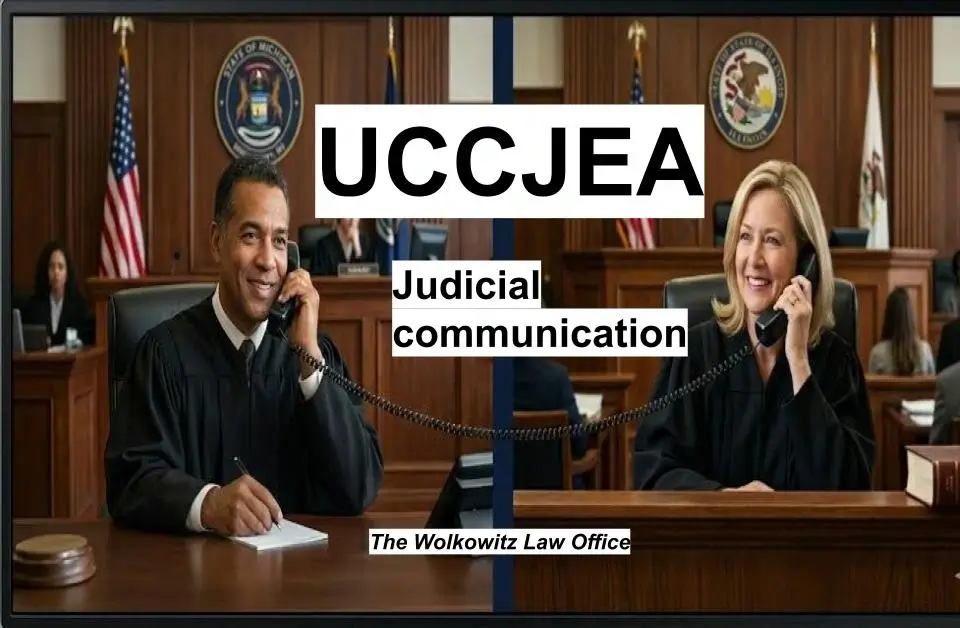
FAQ: UCCJEA judicial communication in interstate child custody cases
If you are involved in an interstate child custody dispute, the you need to know about the Uniform Child Custody Jurisdiction and Enforcement Act, or UCCJEA. When a child custody case spans two states, such as Illinois and Michigan (for example), the UCCJEA provides guidance on judicial communication. Judicial communication, often referred to as a “judicial teleconference,” plays a crucial role in determining the trajectory of the reminder of a UCCJEA case. As a renowned UCCJEA lawyer in Illinois, I’ve put together some information I think is crucial in helping people prepare fort the beginning stages of a UCCJEA case.
(more…) -
Illinois child support: the basics
Whether you might be paying child support or receiving it on behalf of your child, there are certain basics facts you need to know about child support in Illinois. I’ve put together this overview of the Illinois law on child support as reflected in Section 505 of the Illinois Marriage and Dissolution of Marriage Act (the “IMDMA”)(750 ILCS 5/505). (more…)
-
Yes, I’m a Schaumburg Divorce Attorney
Do you need a family law attorney in Schaumburg?
Let’s meet in Schaumburg, in the evening, on weekends . . . whenever. Dealing with your Schaumburg divorce attorney should not be the most difficult part of your divorce. (more…)


