Category: Child Custody

About Illinois child custody disputes in divorce and paternity cases.

  • FAQ: Child custody (“allocation of parental responsibilities”) and visitation (“parenting time”)

    If you have kids and want to get divorced, you’re probably concerned about child custody issues. as in Illinois child custody lawyer, I’ve written this article to answer frequently asked questions about child custody.

    You can contact us online, or text or call 312-554-5433 to get started with your case.

    (more…)
  • Relocation by Deception: UCCJEA Emergency

    Relocation by Deception: UCCJEA Emergency

    If your marriage is breaking down and you like seeing your kids, one of the worst thoughts is probably your kids being taken far away from you. What if your kids were taken from Illinois, to another state, or vice versa? And what if the other parent took your kids away using deception? If you want to avoid being fooled into the losing end of an interstate child custody dispute, you should read this article the discusses relocation by deception and the Uniform Child Custody Jurisdiction and Enforcement Act. You need an Illinois UCCJEA lawyer like attorney David Wolkowitz.

    (more…)
  • Tips on Starting an Illinois UCCJEA case.

    Tips on Starting an Illinois UCCJEA case.

    There are so many things to worry about if you have a UCCJEA case. The UCCJEA, or Uniform Child Custody Jurisdiction and Enforcement Act, is the primary way that states of multiple courts determine in which state a child-related case should be heard.

    If you have an Illinois UCCJEA case, then you need an Illinois UCCJEA lawyer – not any old divorce lawyer who dabbles in the UCCJEA anytime a case happens to roll into the office.

    (more…)
  • 5 Tips for Uncontested Divorce

    Want an uncontested divorce in Illinois? Here are 5 tips that can help make it happen – or call 312-554-5433 to get started now. (more…)

  • FAQ: Factors for Allocation of Parental Responsibilities

    If your are getting divorce with kids in Illinois, then you’re probably thinking about “child custody.” But as of 2017, that’s a term no longer used in Illinois. It’s now called “allocation of parental responsibilities.” Per the Illinois Marriage and Dissolution of Marriage Act, there are various factors a judge is supposed to consider when making an “allocation” decision. As a divorce lawyer in Illinois, I’ve presented the factors in a FAQ format to help you better understand how a court will allocation parental responsibilities.

    (more…)
  • New Illinois “Child Custody” Law: Parenting Agreement Requirements

    As an Illinois divorce lawyer, it’s important to take note of major changed in the law. Beginning January 1, 2016, there term “custody” will not a legal term so far as the Illinois Marriage and Dissolution of Marriage Act (the “IMDMA”) is concerned.  In other words, there will be no more “joint legal custody” or “sole legal custody.” Instead, parents will be allocated various rights in regards to children.

    The movement away from the use of “custody” as a legal term is just one change of many in the new law. That’s why I wrote this article – to help people understand Illinois’ new divorce law as it relates to kids. (more…)

  • Other Parent Run off with your Kid?

    If the other parent has run off with your kid, then you need to take action immediately. I have handled a number of these delicate child custody situations, and I treat them like a sting operation. If your child is taken by the other parent, there are some things you need to know.

    When dealing with any Illinois child custody matter, emotions can run high. However, it’s necessary to play the long game, and to think strategically. Please check out the below article if your child has been take and you find yourself in an Illinois child custody emergency. (more…)

  • New “Right of First Refusal” statute: shame on the legislature

    Many people have heard about a new “right of first refusal” provision that is taking effect on January 14, 2014. As an Illinois child custody lawyer, I find parents are often concerned about this issue. Too bad the new right of first refusal provision is a failure.

    I wrote this article to provide a basic explanation of the law, and some commentary.

    Long story short: the statute has no teeth and doesn’t go far enough in creating and protecting the right of first refusal in child custody and visitation situations. (more…)

  • Child custody: FAQ on child representatives and GAL

    As a Chicago divorce lawyer, I know the process of litigating a child custody dispute in Illinois can be confusing to parents. In Chicago, where there are serious child custody disputes the judge will often appoint a child representative or guardian ad litem (GAL). I wrote this article to help explain those two concepts. (more…)

  • Parenting time: the right of first refusal

    Divorcing parents in Illinois often have conflict over who will spend what time with the kids. As a Chicago divorce lawyer, I find that one way to maximize each parent’s time with the kids is to include a “right of first refusal” in a joint parenting agreement (JPA).

    You may contact me, Chicago divorce lawyer David Wolkowitz online – and read below to learn a bit about the right of first refusal.

    What is a right of first refusal?

    It is never easy to allocate parenting time in an Illinois divorce or child custody dispute – but the right of first refusal can help make this easier. Right of first refusal in custody situations commonly means that one parent must first offer the other parent the opportunity to look after their kids before contacting a babysitter or another family member to care for the children.

    Right of first refusal typically applies to both planned and last minute situations. Therefore, if a parent makes plans for night out with friends two months, or even two days, prior to the actual event, they must offer the other parent the option to care for their children before making any other arrangements. If the other parent decides not to take the kids during this time, then a third party caretaker such as a friend, babysitter or other family member may be asked to care for the children instead. Right of first refusal may also apply to situations such as doctor’s appointments, vacations, after school daycare, and many other instances.

    Benefits of the right of first refusal

    The right of first refusal helps parents avoid conflict because it helps maximize each parent’s time with the children.  Further, when the right of first refusal is included in a JPA, parents are more likely to keep each other informed – and that can lead to better parenting. Ultimately, some of the stress inherent in divorce can be reduced.

    Dealing with your custody issue

    I know that visitation and parenting time can be one of the most contentious issues in a divorce. As an Illinois family law attorney, I think helping my clients spend as much time as possible with their children is one of my most important goals.

    If you are concerned about your time with your children, that’s understandable.You might be interested in a consultation with me, Chicago divorce lawyer David Wolkowitz. You may contact me online or at Three-One-Two-554-5433 .

  • Child custody in Illinois: evidence basics

    As a Chicago divorce lawyer, I tell clients that in a child custody case, most decisions will be made according to the child’s “best interests,” pursuant to Section 601 of the Illinois Marriage and Dissolution of Marriage Act (the “IMDMA”). Therefore, in a child custody matter, a parent’s lawyer needs to apply the law to the sometimes confusing facts of a case.

    Evidence in a child custody case in Illinois

    Parents in a child custody case can be overwhelmed with evidence, or potential evidence. Part of the challenge is to determine what evidence is relevant, and what is not. It’s not productive to spend time on worrying about gathering evidence that would not be meaningful to a judge. Also, as I wrote in my article “Illinois child custody: Liars common, but not invincible,” lying in child custody cases is commonplace – proper evidence can be effective in defeating lies.

    Evidence in a child custody case may include:

    • testimony from parents and others
    • social media websites (Facebook, etc)
    • photographs
    • videos
    • emails
    • text messages
    • psychological reports

    Getting organized

    Parents in a child custody case are rightfully concerned about the cost of the case. To minimize costs, it is important to use a lawyer efficiently.

    When I help a parent gather evidence for an Illinois child custody case, I like to help the parent understand how to organize the evidence, and how to communicate its relevance. As a Chicago child custody lawyer, I know that my clients benefit when I spend less time sorting through mounds of evidence, and more time determining how to best utilize that evidence.

    Keeping the goal in mind

    In a child custody case, the major topics of disagreement are legal custody and parenting time. You will want to gather evidence that is useful for the goal you are trying to achieve.

    Legal custody: Legal custody requires a determination of whether parents will have joint legal custody, or if one will have sole legal custody. Whether a parent has joint or sole custody does not determine how much time the child spends with each parent.

    Parenting time (visitation): One parent may have sole legal custody, but a child still might spend equal time with both parents. Or, parents might share joint legal custody, but the child may spend 80% of his or her time with one parent.


  • Illinois child custody: Liars common, but not invincible

    As a Chicago divorce lawyer, I see people lie frequently. Very frequently. But in a hearing a few days ago, I almost completely dismantled the opposing client under cross-examination.

    Good news: liars are often stupid

    The problem with Illinois family law is that so much of it is “he said, she said.” There is so much “creativity” in testimony that’s it’s a wonder that judges don’t burst out in laughter.

    However, the opposing party in my recent hearing seemingly has no bounds to her dishonesty. Though the case has been going on for more than six months (and my client was previously represented by a high-priced lawyer in a fancy building), the recent hearing was the first one wear the opposing client was actually made to account for her crazy accusations.

    Child custody liar folded under cross examination

    Under my cross examination, the other party stammered like a fool, to say the least. The problem for her was that her lies and intentional mischaracterizations have become so extravagant that she can’t possibly maintain believability.

    I think one of my important tasks is to help my client focus on which of the other party’s lies are potentially substantive, and which are drivel. Then, of the lies that are substantive, I believe in helping my client assembler the evidence required to expose the other party appropriately.

    People that lie in court commit perjury. It is almost impossible to get the state’s attorney to prosecute a perjury case. However, one can also be held in contempt of court for lying in court – an option I’m more than willing to explore for my clients.

    It is important to understand that child custody liars don’t just lie on the stand, they lie at every opportunity, such as in a UCCJEA judicial teleconference when the are trying to effectuate what amounts to a kidnapping; see my article titled “Interestate child custody jurisdiction: UCCJEA ‘judicial teleconference’ is critical” to find out more about that.


  • FAQ: The Illinois UCCJEA

    FAQ: The Illinois UCCJEA

    If you are your spouse, or ex-spouse, is trying to remove your child from Illinois to live permanently in another state, you might become familiar with the the Illinois Uniform Child Custody Jurisdiction and Enforcement Act, or the Illinois UCCJEA. I’m an Illinois UCCJEA lawyer, so I’ve written this article to give parents a basic understanding of the UCCJEA.

    (more…)
  • Illinois’ Family Law Clients’ Bill of Rights

    If you are seeking a divorce in Chicago, Illinois, it is important that you have an attorney that respects your rights. As a client in a family law matter in Illinois, your rights are outlined in Section 508(f) of the Illinois Marriage and Dissolution of Marriage Act, which appears below. (more…)

  • Child custody emergencies: act quickly

    If you have an Illinois child custody emergency, you may need to act quickly.

    Consider the situation encountered by one of my colleagues. He received a very distressing telephone call from a mother in child custody dispute.  She was in an absolute panic. “They’re going to take away my two girls,”  she said.

    She felt there was clear evidence that the father was abusing the children, but she couldn’t make her case in court.

    She tried her best to explain her situation between bursts of tears. The father had hired an attorney and the mother did not.  She said there was a court hearing in only a half hour, and it was about whether the mother would be jailed for disobeying a court order by keeping her children from their father. According to the mother, she had good reason to keep the girls away from their father. But now, she was in hot water – even though she wanted to protect her children.

    She needed a lawyer to help her make her case to the judge that she was justified in disobeying the court order. But by the time she realized she needed help, it was too late.

    If you are in an Illinois child custody dispute, it may very well be in your best interest to consult a Chicago divorce lawyer. While you understandably don’t want to waste money on at attorney, as the case just described shows, you could be setting yourself up for a major problem.

    If you have an Illinois child custody emergency, please contact me, Chicago, Evanston and Schaumburg family law attorney David Wolkowitz; I may be able to help.


  • Kim Kardashian: domestic violence on display before divorce

    Kim Kardashian’s marriage is a hot topic these days. She’s filed for divorce – no surprise there. But the domestic violence she committed against husband Kris Humphries is serious.

    In the context of Illinois marriage, child custody, and divorce, domestic violence is usually viewed as something men commit against women. But it can go both ways, as Kim Kardashian demonstrated while the cameras rolled during the season premier of “Kourtney & Kim Take Manhattan.” Kim seemed to put her full force into hitting her monstrous husband during an argument.Kim Kardashian divorce domestic violence

    Dr. Drew Pinskey said “What you are seeing there is domestic violence . . . A lot of people watching this may not understand this. And I get that. It looks playful. What’s the big deal? But it’s a massive deal … This is an incontrovertible piece of evidence of someone engaged in a domestic violence relationship.”

    Luckily for all Earth’s creatures, the two brainiacs involved in the domestic spat have not produced a child.

    But if they did, and they lived in Illinois, their divorce and child custody case might be complicated by Kim Kardashian’s domestic violence.

    As I discussed in my post titled “Illinois Child Custody Factors,” the presence of domestic violence in a relationship is factor courts may use in determining child custody.  In the context of an Illinois child custody dispute, domestic violence is defined by Section 103 of the Illinois Domestic Violence Act of 19 (750 ILCS 60/103) as “physical abuse, harassment, intimidation of a dependent, interference with personal liberty or willful deprivation but does not include reasonable direction of a minor child by a parent or person [acting in the place of a parent].”

    Here are some things to keep in mind about domestic violence as it relates to child custody disputes:

    • The perpetrator of domestic violence need not be male.
    • The victim need not be heart for domestic violence to be present and used by a judge as a factor to determine child custody.
    • Domestic violence is not limited to physical violence
    People need to use common sense when in a child custody dispute. As a Chicago divorce lawyer, there are few things that bother me more than a person making false allegations of abuse against the other parent. Simply because someone is “mean” or a “jerk” does not mean that domestic violence is present.
    However, if you are truly a victim of domestic violence, then you should consider taking action before your problem gets worse. Please contact me, Chicago, Evanston and Schaumburg family law attorney David Wolkowitz; I may be able to help.


  • Child Custody Emergency Motions: the basics

    As a Chicago divorce attorney practicing in family law, I often deal with critical child custody issues. The most critical can be the other parent’s use of an emergency motion to manipulate a child custody dispute. If an emergency motion has been filed against you, contact me  and I may be able to help you with your child custody emergency. (more…)

  • Parent violating a visitation order? Don’t stand for it!

    If the the other parent is violating a visitation order, you can take action to protect your rights to see your child. If you are having a problem with visitation interference, contact me, Chicago, Evanston and Schaumburg child custody lawyer David Wolkowitz. I may be able to help. Further, you might want to see my previous posts entitled “Court orders: Get them enforced!” and “The crime of visitation interference in Illinois.”

    There are several things you should know about the violation of a visitation order:

    Future violations:

    If you have reason to believe the other parent is going to violate an order in the future, you can have your lawyer file a “motion to compel.” A motion to compel is essentially an order in which the court restates that the other parent should follow a previous court order. For instance, you have visitation with your child next weekend, and the other parent emails you “I’m going to take our child out of town next weekend and there is nothing you can do about it,” that would be sufficient justification for filing a motion to compel. In order words, since the other parent threatened not to follow an order, you may be able to get a court order which essentially repeats the a previous order must be followed. Why the redundancy? If the other parent violates the order even after a motion to compel, then court will probably take an extra-harsh view of the violation.

    Contempt of court for violating a court order:

    When judges issue court orders, they expect them to be followed. When parties don’t follow court orders, the judges get mad. And when judges get mad, the parent that has violated the order can be punished.

    If any court order is violated, including a visitation order, a lawyer can attempt to have the violating party held in contempt of court. For instance, if a court order designates that on a certain holiday the child is to be with Mom, but Dad refuses to turn over the child, then the court could hold Dad in contempt.

    The good news is that if someone is held in contempt of court, the court can require that person to pay the attorney’s fees the innocent parent incurred in trying to enforce the court order. In other words, the person who violated the court order can be made to pay the bill of the parent trying to enforce the order.

    For a more detailed explanation of contempt of court, you may wish to read my post “Court orders: Get them enforced!.”

    Visitation interference in Illinois:

    Previously, I wrote a post titled “The crime of visitation interference in Illinois.” Some lawyers like to publicize the fact that interfering with visitation can be a crime in Illinois. But as I noted in my post, it is difficult to have a parent prosecuted for that crime.

    Instead, a parent who has had his or her visitation interfered with can file a petition for a finding of unlawful visitation interference. At it’s most basic, visitation interference where one parent consistently and habitually deprives or obstructs the other parent’s parenting time.

    What to do if an Illinois child visitation order is being violated:

    The best thing to do if you are having problems with your visitation is to contact me, Illinois child visitation lawyer David Wolkowitz. I will take a look at the facts of your case, and advise you regarding my preception of the strength of your case and the likely outcome.

    Since I understand that it can be difficult to schedule time with a lawyer, it is possible for us to meet near your location, and I offer evening and weekend consultations. To find out more about how I meet with clients, you might view my posts titled “Yes, I’m a Schaumburg Divorce Attorney” or “Yes, I’m an Evanston Divorce Attorney!

    The violation of visitation orders and interference with visitation is serious. If either one is happening to you, it benefits you to act quickly. The longer you wait, the harder it will be to get the results you want.

  • FAQ: UCCJEA judicial communication in interstate child custody cases

    FAQ: UCCJEA judicial communication in interstate child custody cases

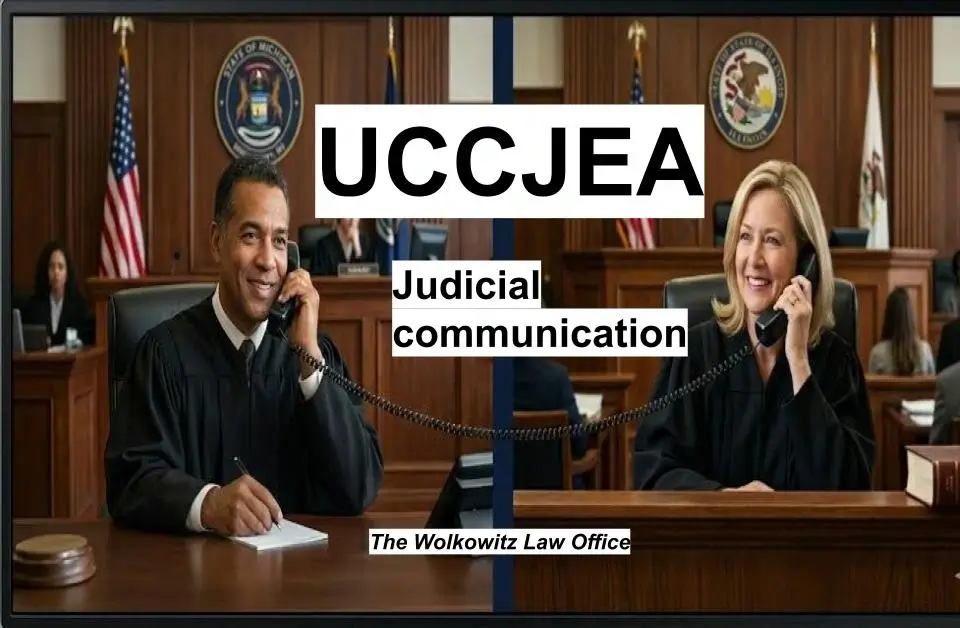
    If you are involved in an interstate child custody dispute, the you need to know about the Uniform Child Custody Jurisdiction and Enforcement Act, or UCCJEA. When a child custody case spans two states, such as Illinois and Michigan (for example), the UCCJEA provides guidance on judicial communication. Judicial communication, often referred to as a “judicial teleconference,” plays a crucial role in determining the trajectory of the reminder of a UCCJEA case. As a renowned UCCJEA lawyer in Illinois, I’ve put together some information I think is crucial in helping people prepare fort the beginning stages of a UCCJEA case.

    (more…)
  • The Crime of Visitation Interference in Illinois

    Visitation interference is common in Illinois child custody disputes. It is also a crime in Illinois pursuant to Section 10-5.5 of the Criminal Code of 1961 (720 ILCS 5/10-5.5). Aside from committing a crime, a person who interferes with visitation would most likely be in violation of a court order; for more information about getting someone to follow a court order, see my post “Court orders: Get them enforced!

    The law states that “Every person who, in violation of the visitation, parenting time, or custody time provisions of a court order relating to child custody, detains or conceals a child with the intent to deprive another person of his or her rights to visitation, parenting time, or custody time commits the offense of unlawful visitation or parenting time interference.”

    Below are some important points about the crime of visitation interference:

    1. Getting prosecution is difficult: The crime of visitation interference is just that – a crime. And because private individuals do not prosecute crimes, the state’s attorney must bring charges. Unfortunately, the state’s attorney has no where near the capacity to pursue every parenting who has committed the crime of visitation interference.
    2. Joint custody creates difficulties with police: Although the statute does not say parents who share joint legal custody are exempt from the crime of visitation interference, many police departments believe that is that case because of their interpretation of an Illinois Supreme Court ruling. Further, police generally do not want to get involved in child custody disputes, so trying to avoid arresting someone for visitation interference is fairly consistent with their general attitudes towards child custody.
    3. Either parent can commit the crime: Traditionally, one parent is viewed as the “residential parent” and the other parent receives visitation, or “parenting time.” And although the law is most commonly though of as applying to interference with visitation specifically, it can also apply to the parent who receives visitation if he or she interferes with the other parent’s court-ordered time.
    4. A non-parent can commit the crime: Even a person who is not a parent can be convicted of the crime of visitation interference. For instance, if a friend of one parent does something to interfere with the other parent’s time with the child, that freind could be convicted of visitation interference.
    If you are having a problem with visitation interference, contact me, Chicago divorce lawyer David Wolkowitz. I may be able to help.
  • Illinois Child Custody Factors

    In Illinois, courts are to determine child custody questions “in accordance with the best interest of the child,” pursuant to Section 602 of the Illinois Marriage and Dissolution of Marriage Act (750 ILCS 5/602). While the court may consider any factor relevant to the child’s best interest, the legislature has directed courts to specifically consider the following factors: (more…)

  • Court orders: Get them enforced!

    A party to a legal proceeding, including an Illinois family law dispute, can be found to be in contempt of court when he or she disobeys a court order.Illinois family law judge, Chicago divorce court judge

    If you are involved in an Illinois family law case and the other party is not obeying a court order, then you should take action to see that the court order is enforced. For instance, the other party may refuse to follow an order from visitation, may not be paying child support according to a court order, or may otherwise be in violation of an Illinois family law court order.

    The good news about seeking to have another party held in contempt of court is that, if the court finds the other party to be in contempt of court, the other party often has to pay your attorney fees. In other words, you can hire an attorney to get your court order enforced, and often the other person has to pay for it!

    If you are having problems getting the other parent to follow court orders, contact me – Chicago divorce lawyer David Wolkowitz. I may be able to help. Also, check out my post titled “The Crime of Visitation Interference in Illinois.”